


The adoption of AI agents in finance is wildly uneven. One 2025 survey projected a roughly six-fold jump in finance teams using agentic AI in 2026, while a separate 2026 survey found under 10% of treasury teams were actually using AI for core functions like forecasting. Both numbers are true. They're just measuring different points on a very long adoption curve. Agentic finance is about thirteen different categories, moving at thirteen different speeds.
The categories of agents that only advise are moving fast, because a bad forecast is embarrassing, not catastrophic. The categories where the agent actually acts - where it can spend, trade, or sign something - are moving a lot more carefully.
Vendors mostly won't tell you which side of that line their product sits on, because "advisory tool" undersells the pitch and "fully autonomous" overstates the reality. So that's the lens for everything below, not the framing any given vendor chooses: whether the agent is allowed to act or only allowed to advise.
Agentic finance: who acts, who advises
Every category in the agentic finance stack sorts into one of three lanes based on what the agent is actually allowed to do.
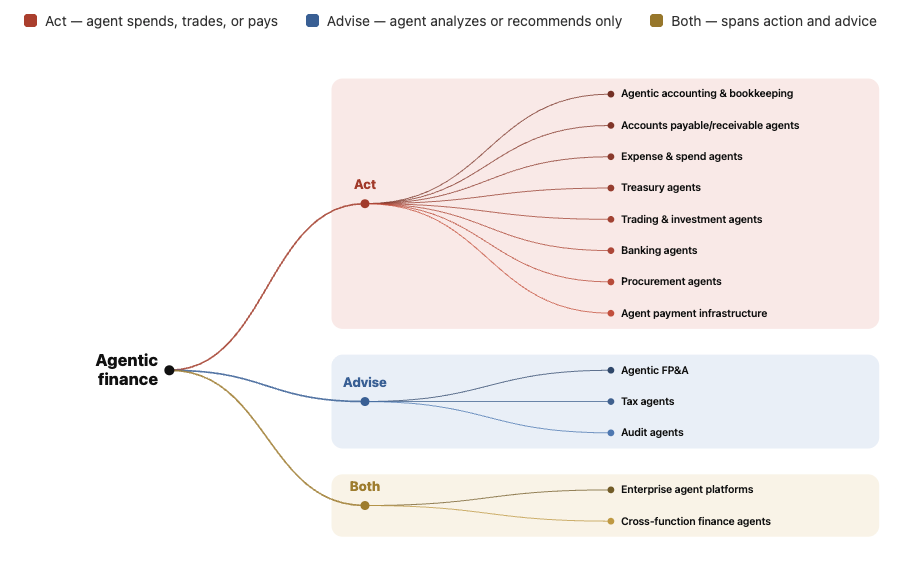
Agents that Act
These are the categories where the agent can actually spend your money.
Agentic accounting & bookkeeping
Bitwave Agentic is probably the purest example of this category. The central component of the Bitwave Agentic suite is Bitwave CLI, a command-line tool that lets an AI agent keep its own books, using plain double-entry accounting the agent can't fudge (an entry either balances or the tool refuses to save it). Any AI agent that spends money on its own (API costs, subscriptions, on-chain transactions) needs a ledger it can't lie to.
It's not alone in the category. Ramp's Accounting Agent auto-codes every transaction across your GL and posts accruals, surfacing only the weird stuff. Basis just raised at a $1.15 billion valuation and, per its own numbers, is already working with a meaningful chunk of the top 25 accounting firms. Rillet, Puzzle, and Truewind are all building some version of "the ledger updates itself now."
Agentic accounting & bookkeeping
The same idea applied to the inbox: Vic.ai, HighRadius, Stampli, Tipalti, and AppZen all read an invoice, three-way-match it against the PO and the receipt, code it to the right GL account, and route it for approval or payment. This is probably the single most "solved" corner of agentic finance, in the sense that invoice processing is a bounded, repetitive task that AI is legitimately great at, and the vendors here report genuinely high rates of touchless processing.
Expense and spend agents
Ramp again, Brex, Navan, Emburse, and SAP Concur all do roughly the same thing for your corporate card, flagging out-of-policy spend in real time instead of during the miserable monthly review nobody wants to do.
Treasury agents
Kyriba, GTreasury, FIS, Bottomline, and Trovata monitor cash positions and forecast liquidity - mostly advisory work today - but they sit in Act rather than Advise because the platforms underneath are built to execute the resulting wire or FX trade, not just recommend it, even though that execution step is almost always gated by a separate human approval.
Trading and investment agents
Maybe the most-covered and least-uniform category. It includes everything from Robinhood's agentic trading features for retail, to crypto-exchange agent toolkits from Kraken, Binance, OKX, and Coinbase that let a bot place trades directly, to a wave of prosumer tools like AInvest. Institutionally, the pattern is different and, frankly, more boring in a good way: hybrid systems where an LLM proposes a thesis and a separate, non-negotiable risk layer gets a veto. Nobody serious has built a trading agent with no risk layer, because that's not a product, that's a lawsuit.
Banking agents
This is where the giants live. JPMorgan Chase has reportedly deployed hundreds of production AI use cases across a platform processing something like $10 trillion a day; Goldman Sachs is co-building autonomous agents with Anthropic for trade reconciliation and compliance; Bank of America's "Erica" assistant handles tens of millions of users. Oracle has shipped a dedicated agentic banking platform. The theme across all of them is fraud detection, compliance monitoring, and customer service at a scale no human team could staff - with, again, a human review layer sitting on top of anything that touches an actual account balance.
Procurement agents
Coupa, Zip, SAP Ariba, GEP SMART, and Ivalua vet suppliers, triage requisitions, and increasingly just issue the purchase order themselves. Coupa in particular has been on an acquisition and agent-building spree, with dozens of specialized agents running against what's reportedly a spend dataset in the trillions.
Agent payment infrastructure
This isn't a "product" category so much as the plumbing everyone else needs. This is Google's AP2 protocol (which uses cryptographically signed "mandates" so an agent can prove exactly what it was authorized to buy, for how much, by whom), Coinbase's x402 (a stablecoin micropayment protocol that just crossed 165 million cumulative transactions), Visa TAP and Mastercard Agent Pay (the card networks' answer to "how does an agent prove it's allowed to use this card"), and Stripe's whole agentic commerce toolkit. This is the least glamorous category and arguably the most important one, because it's the layer that answers the actual scary question - not "can the agent do the math" but "how do we know it was allowed to do this, and how do we shut it off if it wasn't."
Bitwave's own CEO has made the case that agents will transact in digital assets before they ever touch a bank rail, on the simple logic that stablecoins settle in seconds and ACH does not.
Agents that Advise
These are the categories where the robot just tells you what it thinks.
Agentic FP&A
Pigment, Cube, Datarails, Aleph, and Drivetrain generate forecasts, run scenarios, and explain variances, continuously and (mostly) without touching a real dollar. This is the cleanest "advise" category on the whole chart: a bad forecast is embarrassing, not irreversible, so the guardrails here are lighter and the pace of adoption faster.
Tax agents
Black Ore, Filed, Magnetic, Bizora, and TaxGPT draft returns and workpapers from source documents for a preparer to review and sign.
Audit agents
MindBridge, DataSnipper, Trullion, and Auditor Intelligence analyze entire transaction populations instead of a sample, flagging anomalies for a human reviewer to chase down. This is, in a sense, the honest cousin of everything in the Act column: it's the category whose entire job is to double-check the other categories.
Agents that Do Both
Enterprise agent platforms
SAP, Oracle, Microsoft, Workday, Intuit, Xero, and Salesforce have all shipped agentic features that span the full range, from a Concur agent that reads a receipt (advise-ish) to a Joule agent that posts to the GL (definitely act). These are less "a category" than "every incumbent's answer to the category," mostly built on top of Claude or similar models via MCP.
Cross-function finance agents
Ema, Freehand, ChatFin, Nekuda, and Proxy are the horizontal players: instead of specializing in AP, or FP&A, or tax, these are built to sit across several finance functions at once and move between them. It's the newest and least settled category on the chart, which feels right, since "an agent that just does the whole finance function, not one slice of it" is the natural next thing to try once the individual slices are working.
Caveat: don't fully believe the vendor decks
A few caveats, because a blog post that just repeats every vendor's own numbers back at you isn't actually useful. The accuracy stats, the touchless-processing percentages, the "99% accurate" claims are marketing, not audited disclosures, and should be read that way. The adoption gap I mentioned up top is worth keeping in mind for basically every category above: a company "shipping an agent" and a company "letting that agent act with no human in the loop" are very different sentences, and press releases tend to blur the two.
The only question worth asking
You need one question, and you can ask it about literally any "AI agent for finance" product that shows up in your feed next month: is this agent allowed to act, or only allowed to advise?
That single question tells you more than most press releases will. It tells you how much oversight the thing actually needs, roughly how fast it's likely to get adopted, and whether the vendor is being straight with you about which one it is, because the honest answer is usually somewhere in between.
If you want to see that distinction handled about as literally as possible, Bitwave Agentic is worth a look. It's built for the highest-stakes version of "act" (an AI agent actually spending money) and answers the oversight question by keeping a ledger the agent can't lie to. Not a bad place to start if you're wondering what "act, carefully" looks like in practice.
Vendor lists throughout are illustrative, not exhaustive, and reflect the most prominent named players per category as of August 2026, compiled from public vendor announcements, funding disclosures, and press coverage. Nothing here is investment advice, and nothing here is a ranking.


Disclaimer: The information provided in this blog post is for general informational purposes only and should not be construed as tax, accounting, or financial advice. The content is not intended to address the specific needs of any individual or organization, and readers are encouraged to consult with a qualified tax, accounting, or financial professional before making any decisions based on the information provided. The author and the publisher of this blog post disclaim any liability, loss, or risk incurred as a consequence, directly or indirectly, of the use or application of any of the contents herein.