

Yesterday, we introduced the Bitwave CLI, an open-source command-line interface designed to give AI agents programmatic access to financial data and workflows.
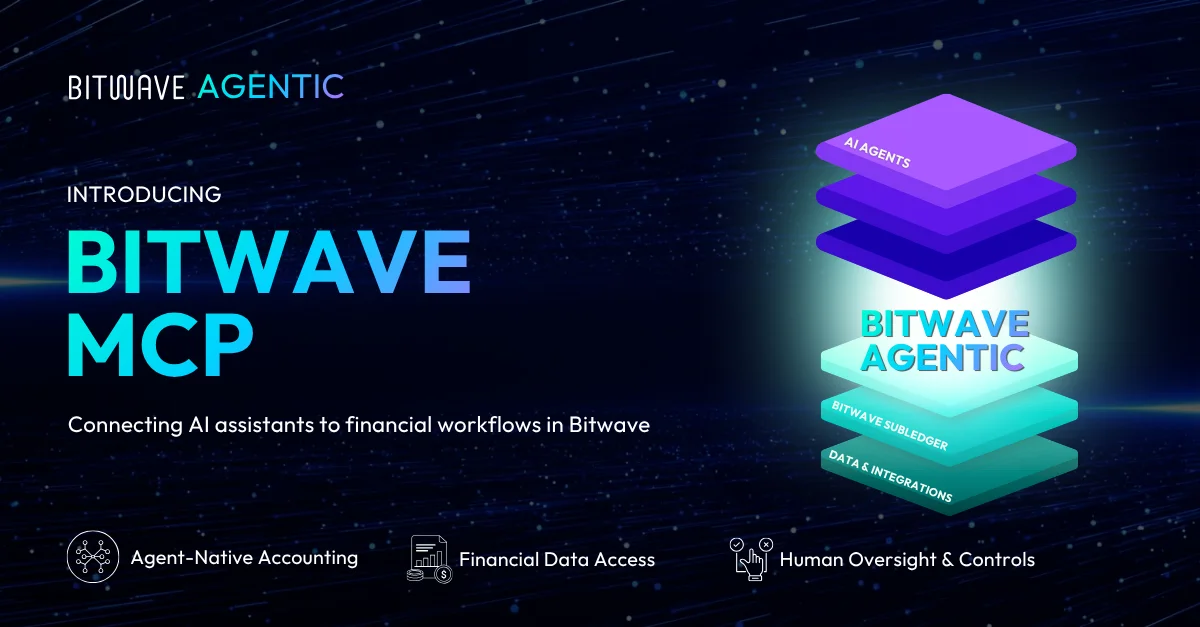
Today, we’re introducing another way for agents to work with Bitwave: the Bitwave Model Context Protocol server, or Bitwave MCP.
Bitwave MCP allows supported AI applications and agentic tools to connect directly to Bitwave through a standardized, authenticated interface. Once you sign in and authorize the connection, your agent can access supported Bitwave data and capabilities, making it easier to investigate activity, complete routine work, and get answers without navigating every workflow manually.
What is an MCP?
The Model Context Protocol is an open standard that allows AI applications to connect to external tools and data sources.
Think of it as a common interface between an AI agent and the software you use. Instead of copying transaction data into an AI conversation or asking the model to work without the necessary business context, an MCP connection allows the agent to interact with approved Bitwave tools on your behalf.
You remain in control of the connection: the agent must be authenticated and authorized before it can access your Bitwave environment.
What can an agent do with Bitwave MCP?
The initial Bitwave MCP release supports a focused set of common workflows, including:
- Viewing transactions and transaction details
- Reviewing connected wallets
- Adding a wallet
- Categorizing transactions
- Running supported reports
- Investigating financial activity through conversational prompts
For example, a user could ask an authorized agent to find transactions that still require categorization, review the activity associated with a particular wallet, or pull information needed for a report.
This first release is only the beginning. We’ll continue expanding the available capabilities so agents can support more of the work finance teams perform in Bitwave.
Bitwave MCP or Bitwave CLI?
Bitwave MCP and the Bitwave CLI offer two complementary ways for AI agents to interact with Bitwave.
Bitwave MCP is designed for interactive, user-authorized workflows inside MCP-compatible AI applications. It provides a straightforward way to connect an agent to Bitwave and work conversationally with supported data and tools.
The Bitwave CLI provides a more flexible interface for developers and teams building deeply automated or autonomous financial workflows. It is the better fit when an agent needs broader programmatic access, needs to perform general-ledger work, or will operate as part of a larger automated system.
In simpler terms: use Bitwave MCP to work with Bitwave alongside your agent. Use the Bitwave CLI to build Bitwave into the agent’s operating environment.
Making financial software accessible to agents
Financial software was designed around humans clicking through interfaces. AI agents require a different access layer: one that allows them to discover available tools, retrieve the right context, and take authorized action.
Bitwave MCP brings that access model to enterprise digital-asset finance. It gives finance professionals a practical way to begin incorporating agents into existing workflows—while maintaining the authentication and user authorization expected from enterprise financial systems.
The goal is straightforward: help you get more out of Bitwave, automate more of the repetitive work, and spend less time manually hunting for information.
Bitwave MCP is available now. Request early access to learn more and connect your agent.
FAQs Related to Bitwave MCP
What is the Model Context Protocol and how does it work with Bitwave?
The Model Context Protocol is an open standard that allows AI applications to connect to external tools and data sources. Bitwave MCP uses this standard to let AI agents interact with approved Bitwave tools and data through a common interface, rather than requiring manual data entry or agent operation without business context.
What tasks can an AI agent perform through Bitwave MCP?
Agents can view transactions and details, review connected wallets, add wallets, categorize transactions, run supported reports, and investigate financial activity through conversational prompts. The initial release supports these common workflows, with more capabilities planned for future releases.
How does Bitwave MCP maintain security and control?
You remain in control of the connection—agents must be authenticated and authorized before accessing your Bitwave environment. This ensures the agent can only interact with approved tools on your behalf, maintaining the authentication standards expected from enterprise financial systems.
Should I use Bitwave MCP or Bitwave CLI for my needs?
Use Bitwave MCP for interactive, user-authorized workflows inside compatible AI applications where you work conversationally with your agent. Use the Bitwave CLI if you need broader programmatic access, plan to perform general-ledger work, or are building a larger automated system.
Is Bitwave MCP available now?
Yes, Bitwave MCP is available, though early access may be required. Interested users can request early access to connect their agent and learn more about the service.

Disclaimer: The information provided in this blog post is for general informational purposes only and should not be construed as tax, accounting, or financial advice. The content is not intended to address the specific needs of any individual or organization, and readers are encouraged to consult with a qualified tax, accounting, or financial professional before making any decisions based on the information provided. The author and the publisher of this blog post disclaim any liability, loss, or risk incurred as a consequence, directly or indirectly, of the use or application of any of the contents herein.