

There's a question that comes up in every enterprise blockchain treasury implementation: "Can we just use our existing ERP?"
The short answer is no. The long answer is "technically yes, but you'll spend $500K in consulting fees, your close cycle will triple in length, and your auditors will hate you."
At Bitwave, we've seen this movie dozens of times. We've watched companies bolt blockchain onto NetSuite, force crypto transactions into SAP, and build elaborate Excel reconciliation workflows that collapse the first time someone leaves for a different job. We've sat in conference rooms while controllers explain why the month-end close now takes 15 days instead of 3. We've reviewed qualified audit opinions that could have been avoided.
After working with enterprises on digital asset treasury—from Fortune 500s testing stablecoin payments to institutions managing billions in client crypto assets—we've developed a pretty clear picture of what actually works versus what just looks good in demos.
These are the things finance leaders wish they'd known before their first implementation.
1. Your Blockchain Data Isn't "Immutable Truth" for GAAP Purposes
Despite blockchain's reputation for transparency and immutability, raw chain data is essentially useless for financial reporting.
A blockchain transaction tells you that 1.5 ETH moved from one address to another at a specific timestamp. It doesn't tell you:
- Whether that was a purchase, sale, transfer, or fee payment
- What the cost basis was
- What the fair market value was at transaction time
- How to account for it under GAAP or IFRS
- Whether it triggers impairment testing
- Which GL accounts should be debited and credited
This is the gap where most implementations break down. Companies treat blockchain as their "source of truth" and assume the data is inherently audit-ready. It's not. Blockchain data needs enrichment, categorization, valuation, and proper accounting treatment before it becomes useful for financial reporting.
The translation layer between blockchain transactions and accounting entries is where the actual work happens. Companies that skip this step end up with controllers manually categorizing thousands of transactions in spreadsheets, trying to reverse-engineer what happened months ago when the cost basis information is long gone.
2. The Audit Trail Gap Is Your Biggest Hidden Risk
Here's what happens in a typical blockchain treasury audit: The auditors ask to see your crypto holdings. You show them the blockchain addresses. They ask to see how those holdings are reflected in your general ledger. You show them the GL entries. Then they ask the question that breaks everything: "Can you prove the connection between these two things?"
Most companies can't.
They can show blockchain transactions. They can show accounting entries. But they can't produce a complete audit trail that connects:
- The authorization (who approved the transaction)
- The wallet transaction (what actually happened on-chain)
- The custodian confirmation (third-party verification)
- The accounting entry (what hit the books)
- The supporting documentation (cost basis, FMV, methodology)
This is why crypto audits take three times longer than traditional audits. Auditors spend weeks reconstructing transactions because the systems don't maintain proper chain of custody. In the worst cases, they issue qualified opinions because they can't verify balances or movements.
Bitwave maintains this complete audit trail automatically. Every blockchain transaction is linked to its accounting treatment, supporting documentation, and approval workflow. When auditors ask questions, you can produce answers in minutes instead of weeks.
3. Your ERP Wasn't Built for This (And Bolting It On Makes It Worse)
NetSuite doesn't have a field for "smart contract interaction." SAP wasn't designed with "liquidity pool positions" in mind. QuickBooks has no concept of "gas fees paid in ETH to execute a USDC transfer."
This seems obvious, but companies consistently underestimate how fundamentally different blockchain transactions are from traditional financial activity. The result is elaborate workarounds:
- Creating dozens of custom fields that break with every ERP update
- Building separate systems that feed data to the ERP via CSV imports
- Manually reclassifying transactions because the automation can't handle edge cases
- Maintaining parallel records because the ERP can't properly track cost basis
The correct approach is a proper subledger that speaks both languages fluently. It understands blockchain-native concepts (gas fees, protocol fees, staking rewards, impermanent loss) and translates them into accounting concepts that ERPs understand (expenses, income, asset appreciation/depreciation).
This approach is more sophisticated than forcing blockchain data into ERP fields. A dedicated crypto subledger provides an intelligent translation layer that maintains the fidelity of blockchain transactions while producing clean, standard accounting entries that integrate seamlessly with existing financial systems.
The difference shows up in practice. Companies with proper sub-ledgers sync their blockchain activity to their ERP in real-time with full reconciliation. Companies without them spend the first week of every month manually reconciling spreadsheets and hunting down unexplained variances.
4. Multiple Accounting Treatments Aren't Optional
Let’s say a multinational enterprise holds digital assets that need to be reported under US GAAP for SEC filings, IFRS for their European subsidiary, and local standards for other jurisdictions. Each framework has different rules for valuation, impairment, and recognition.
Under current US GAAP, crypto assets are treated as indefinite-lived intangible assets subject to impairment testing. Under IFRS, they might be inventory or intangibles depending on the business model. The cost basis method might be FIFO in one jurisdiction and weighted average in another.
Most blockchain treasury tools force you to choose one treatment. If you need multiple perspectives on the same data, you're maintaining separate instances or building complex manual adjustments. This doesn't scale, and it creates enormous risk. If your manual adjustments are wrong, your financial statements are wrong.
Enterprise-grade treasury management means applying multiple accounting treatments to the same underlying transactions without doubling your work. You configure different valuation settings, cost basis methods, and recognition rules for each set of books. The system maintains them simultaneously, all flowing from the same source data.
This isn't theoretical. Public companies with Bitcoin on their balance sheets need this. Institutions managing client assets across jurisdictions need this. Any enterprise with international operations needs this.
5. The Real ROI Is Time-to-Close, Not Transaction Fees
Finance teams evaluating blockchain treasury solutions spend enormous time comparing custody fees, transaction costs, and gas efficiency. These matter, but they're optimizing for the wrong metric.
The real cost of inadequate blockchain treasury management shows up in your close cycle:
- Controllers manually reconciling custodian reports with internal records
- Accountants categorizing transactions one-by-one because automation failed
- Finance teams working weekends to meet reporting deadlines
- Delays in producing investor reports because the numbers aren't ready
- Inability to make real-time treasury decisions because you don't have current data
Companies with proper blockchain treasury management close their books in 2-3 days. Companies without it spend 10-15 days on close, with finance teams working overtime to manually complete tasks that should be automated.
The ROI calculation isn't "how much did we save on transaction fees." It's "how much faster can we close, how much more accurate are our reports, and how much time did we free up for strategic work instead of manual reconciliation."
CFOs understand this instinctively. They know that saving $10K annually on custody fees doesn't matter if you're spending $200K in additional labor on manual close processes. They know that "always audit-ready" beats "scrambling when auditors arrive."
6. Technology Alone Isn't the Solution
Companies evaluating blockchain treasury solutions often don’t know where to start looking, so they search for features more than a system. Does it support this blockchain? Can it integrate with that custodian? Does it handle DeFi? The tool with the best feature matrix comes out on top of their search, and they think the problem is solved.
Then implementation starts. And they discover that features don't matter if they don't know how to use them. Questions arise that the software can't answer:
- How should we structure our chart of accounts for digital assets?
- What's the right cost basis method for our tax strategy?
- How do we configure our workflows to maintain proper segregation of duties?
- What documentation do we need to maintain for audit purposes?
- How do we handle this edge case that didn't come up in the demo?
The software documentation doesn't help because software can’t answer questions about accounting, tax, compliance, and process design.
Companies that succeed with blockchain treasury combine three elements:
- Technical infrastructure that actually works (proper sub-ledger, ERP integration, audit trails)
- Strategic advisory on governance, risk management, and controls
- On-demand expertise from people who understand both blockchain and accounting
This is why implementation success rates vary so dramatically. The technology itself isn't the differentiator. The vast majority of treasury system failures are implementation and change management issues, not product deficiencies.
You need people who can design your workflows, configure your accounting treatments, train your team, and answer the questions that inevitably arise when you're dealing with something as novel as blockchain treasury management. The companies that try to go it alone with technology typically end up back at the drawing board six months later, having burned through budget and patience.
What Institutional-Grade Actually Means
After working with institutional finance teams and alongside their advisors from firms like Deloitte, we've learned that enterprise blockchain treasury management requires a fundamentally different approach than what most vendors offer. That's why we've partnered with firms like Deloitte and RSM rather than trying to solve these challenges with technology alone.
As Rob Massey, Partner at Deloitte Tax LLP, puts it: "Bitwave's sub-ledger offering brings a thoughtful approach to supporting the complex nature of digital asset-based transactions. Our complementary skillsets will bring unique opportunities to collaborate."
That "thoughtful approach" means understanding that blockchain treasury is a multi-layered problem where technology is only one solution. It's also an accounting problem, a compliance problem, an integration problem, and a process problem. Those require technology, but technology alone doesn't solve them.
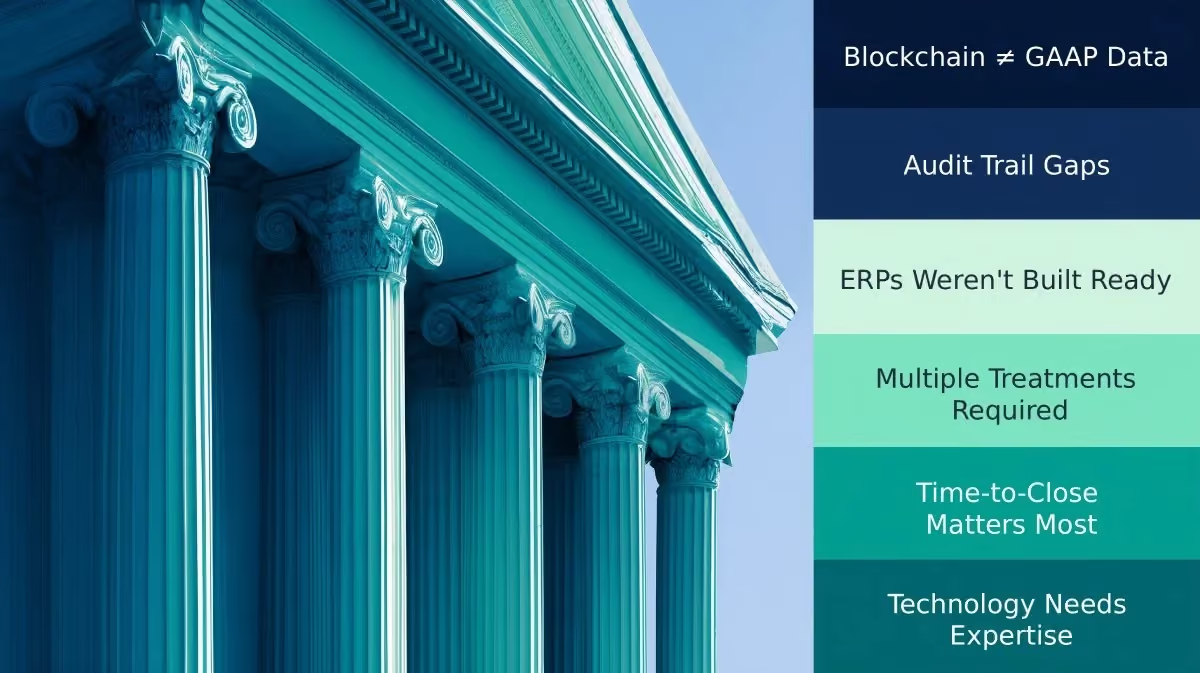
The Bitwave approach addresses all six insights:
- A sub-ledger architecture that properly translates blockchain data into accounting data (#1)
- Complete audit trails that connect on-chain activity to GL entries (#2)
- Purpose-built ERP integration instead of crude bolt-ons (#3)
- Multi-treatment accounting capabilities for complex reporting requirements (#4)
- Automated workflows that compress close cycles from weeks to days (#5)
- Partnership with strategic advisors like Deloitte who bring complementary expertise (#6)
This is what separates blockchain treasury solutions that look impressive in demos from ones that survive Big 4 audits, meet SEC reporting requirements, and actually close the books on time. If you're evaluating options or struggling with a solution that's not working, these six insights provide a framework for asking better questions about what you actually need. This is how you build blockchain treasury management that actually works in production, not just in theory.
Ready to see what institutional-grade blockchain treasury management looks like? Schedule a demo to learn how leading enterprises are solving these challenges.


Disclaimer: The information provided in this blog post is for general informational purposes only and should not be construed as tax, accounting, or financial advice. The content is not intended to address the specific needs of any individual or organization, and readers are encouraged to consult with a qualified tax, accounting, or financial professional before making any decisions based on the information provided. The author and the publisher of this blog post disclaim any liability, loss, or risk incurred as a consequence, directly or indirectly, of the use or application of any of the contents herein.