

Key Takeaways
- A crypto treasury strategy is built around four pillars—governance, liquidity, cash flow, and diversification—but those pillars don't explain how to operationalize digital assets inside a finance function that runs on NetSuite and closes monthly under GAAP.
- Blockchain data isn't inherently finance-ready: a transaction shows that assets moved between addresses, but not whether it was a purchase, fee, staking reward, or intercompany transfer, or what cost basis and GL treatment apply.
- Common operational gaps include ERPs with no fields for gas fees or liquidity pool positions, and an audit trail gap where companies can show blockchain transactions and GL entries separately but can't prove the connection between them.
- Bitwave's subledger enriches and categorizes every transaction before it reaches the ERP, enforces governance through approval workflows tied to the audit trail, consolidates treasury positions across wallets and custodians, and syncs to ERPs like NetSuite and SAP in real time.
- Companies with this infrastructure typically close their books in 2-3 days versus 10-15 days without it, and Bitwave pairs its technology with advisory partners like Deloitte and RSM for the accounting and compliance judgment calls software alone can't make.

Say a company - maybe a mid-size enterprise, maybe a public company with a board that just read about MicroStrategy - decides it wants a crypto treasury strategy. The CFO and treasury team spend months thinking carefully about asset allocation, custody partners, risk tolerance, and governance frameworks. They decide what to hold, how much of it, and why. They present the strategy to the board, the board approves it, and everyone feels good about the decision.
Then it lands on the controller's desk.
That is where the strategy starts to fall apart. The strategy itself wasn't a bad one, but nobody planned for the operational reality of actually running one. The accounting doesn't fit neatly into the ERP. The audit trail isn't there. Month-end close, which used to take three days, now takes two weeks. The auditors have questions nobody can answer quickly.
This guide is for what happens after you have a crypto treasury strategy (and if you need guidance on how to create one, we've got you covered there too). Along the way, you'll learn how Bitwave handles the operational side so your finance team doesn't spend every month reconstructing what happened on-chain.
What is a Crypto Treasury Strategy?
A crypto treasury strategy - sometimes called a Digital Asset Treasury, or DAT - is the formal practice of acquiring, holding, and managing digital assets such as Bitcoin, Ethereum, or stablecoins as a structured part of corporate treasury management. Rather than treating crypto as a one-off investment, a DAT strategy integrates digital assets into the company's broader financial playbook.
The reasons companies pursue them vary: inflation hedging, balance sheet diversification, market signaling to investors, faster cross-border settlement via stablecoins, or simply staying aligned with a blockchain-driven economy.
Any solid strategy is built around four pillars:
- Governance — who controls assets, who can authorize transactions, and how decisions are made
- Liquidity — maintaining access to assets and ensuring private keys are secured and accessible
- Cash Flow — generating yield through staking, lending, or other mechanisms
- Diversification — spreading exposure across assets, exchanges, and custodians to limit downside risk
What the four pillars don't tell you is how to operationalize any of it inside a finance function that runs on NetSuite, reports under GAAP, and has to close the books every month.
The Operational Gaps That Catch Finance Teams Off Guard
The most common misconception in crypto treasury management is that blockchain data is inherently finance-ready. It isn't. A transaction on-chain tells you that 2 ETH moved from one address to another at a given timestamp. It does not tell you whether that was a purchase, a fee payment, a staking reward, or an intercompany transfer. It does not give you a cost basis, a GL code, or an accounting treatment.

Hi everyone, welcome to another Bitwave Quick Hit. Today we're talking about digital asset treasury. Pat, more and more enterprises are getting into crypto — what do treasury teams at these companies need to think about?
Pat WhiteTreasury teams are expected to be conservative — minding the shop, keeping money safe. The hard truth is that crypto moves fast and will push treasury teams harder than they're used to. You're going to have to adapt and think about things differently.
The biggest difference between traditional assets and digital assets comes down to risk profile — and specifically, how many layers of risk you're now responsible for. With a traditional asset, you think about asset risk. If you buy Coca-Cola stock, it goes up and down, but you're not worried that JP Morgan gets hacked and your shares get swept into someone else's account. That scenario simply doesn't exist in traditional securities. With crypto, it absolutely can happen.
Start at the bottom layer: network risk. Whether it's Solana, Ethereum, or Bitcoin, every major blockchain has had a serious network-level incident — price disruption, assets moved unexpectedly, or a full network halt. Bitcoin had a halt early in its life. Solana still experiences them periodically. You can wake up unable to move assets no matter what you want to do. So you have to think about risk not just at the asset level, but at the network level underneath it.
The next layer is custodial or counterparty risk. If you're working with a custodian — Coinbase, BitGo, whoever — you need to be doing ongoing risk analysis of them. Are they a solid partner? What are they charging you? Custodial fees represent a daily leakage of value, and you need to factor that in alongside the risk that the custodian itself could be compromised.
If you're self-custodying, that's a different problem entirely. Most enterprise treasury teams haven't had to think about the equivalent of a cash box before — the operational security implications of private keys. Any developer on your team might have a wallet that happens to hold a token that moons and is suddenly worth $3 million. That doesn't happen with cash registers. You need to know where every private key is, who has access, and you need monitoring and alerts when new wallets are created. If someone who holds a private key gets fired, what do you do? If they decide to disappear to Costa Rica with their moon money, how do you recover? Do you have a key management strategy? Key backups?
And then on top of all that, there's asset-level risk. USDC is stable, but Bitcoin — which is stable in a broad sense — recently saw a $15,000 swing over three days, from $75k down to $60k and back to $67k. For a treasury team, that kind of volatility is not comfortable. So to summarise: you're thinking about network risk, custodial or counterparty risk, employee and operational security risk, and then asset-level risk on top. Traditional treasury risk thinking — yield risk, bank risk, systemic monetary risk — doesn't cover it. Crypto requires a much more holistic, layered approach.
Amy Kalnoki
Let's drill into it. How do digital assets differ from regular assets?
Pat WhiteA few things to know. First, the volume and speed of money. Crypto moves very quickly, and any business getting serious about digital assets will see transaction counts skyrocket. The number of wallets will be enormous. I was at a conference happy hour once talking to a sales executive from a treasury management system, and I asked how many bank accounts a large multinational like Coca-Cola typically has. He said something like 600. In the crypto world, that's a tiny number — one of our smaller customers easily has 600 to 1,000 wallets. A larger customer can have 10,000 to 100,000.
Traditional treasury management systems simply aren't built for this. Many can't accommodate 10,000+ wallets. They can't handle the asset types. And if you try pushing 100,000 transactions a day through a traditional cash subledger, it will either break or hand you a very large cloud bill. BitWave is built to handle this at scale and can integrate into your treasury management system — pushing data into Kyriba, GTreasury, and similar platforms. But you need to be prepared to adopt new processes and new tools to get the data you actually need.
Amy Kalnoki
Treasury traditionally manages yield and sweeps funds to payments accounts. How do those traditional treasury functions work in the digital asset world?
Pat WhiteFirst and foremost: observability. You get BitWave, connect all your wallets, and now you have visibility across all your assets across all your systems. From there you can start making yield decisions.
There are a huge number of ways to generate yield in crypto — some more legitimate than others. The starting point is your stablecoins. A stablecoin sitting idle in a wallet is essentially a T-bill you're not collecting yield on. You've taken on the risk profile of the underlying instrument but none of the return. So the first move is to optimise which stablecoins you hold and work with custodians that will share yield with you.
A good example: Coinbase and Circle have partnered so that if you hold USDC on Coinbase, Circle shares the yield from the T-bills and bonds backing the stablecoin — you can earn around 3.5% to 4%. It's slightly riskier because they tend to use shorter-term T-bills (90-day instruments), but if that fits your risk appetite, it's about the lowest-risk yield option available in crypto. From there the risk spectrum scales all the way up to DeFi yield farming, which can generate higher returns but with substantially more risk. If you have someone on your team who's passionate about it, putting a small portion of funds to work that way isn't unreasonable — just don't put everything there.
Be cautious of companies that offer to re-hypothecate your Bitcoin and pay you yield on it. Many of those businesses have gone under, and some were operating illegally. The safest path is finding a reputable exchange that will pass back a portion of the T-bill yield your stablecoin issuer is already earning.
Second, once you have good observability in place, you can start building sweep strategies. BitWave can alert you when wallets hit certain thresholds and help you fund accounts based on projected spend for the coming week or month. Yield automation and sweep automation are both possible. That said, the kind of sophisticated treasury orchestration you might be used to from a traditional TMS — complex sweep rules, multi-leg movements — is still relatively nascent in the crypto world. BitWave is building more of this capability, but come into it with realistic expectations and be ready to iterate as the tooling matures.
Amy Kalnoki
Thanks so much, Pat. Really helpful overview of crypto treasury operations.
ERP systems compound the problem. NetSuite doesn't have a field for gas fees. SAP wasn't designed with liquidity pool positions in mind. The typical response - bolt crypto onto the existing ERP with custom fields and CSV imports - works until it doesn't, and it usually stops working around the third month-end close.
Then there's the audit trail problem. Auditors will ask you to prove the connection between what happened on-chain and what's in your general ledger. Most companies can show blockchain transactions. Most can show accounting entries. What they can't easily produce is a clean, documented chain from authorization through on-chain execution to the GL entry - and that gap is what turns a three-week audit into a three-month one.
How Bitwave Handles the Execution Side of Your Treasury Strategy
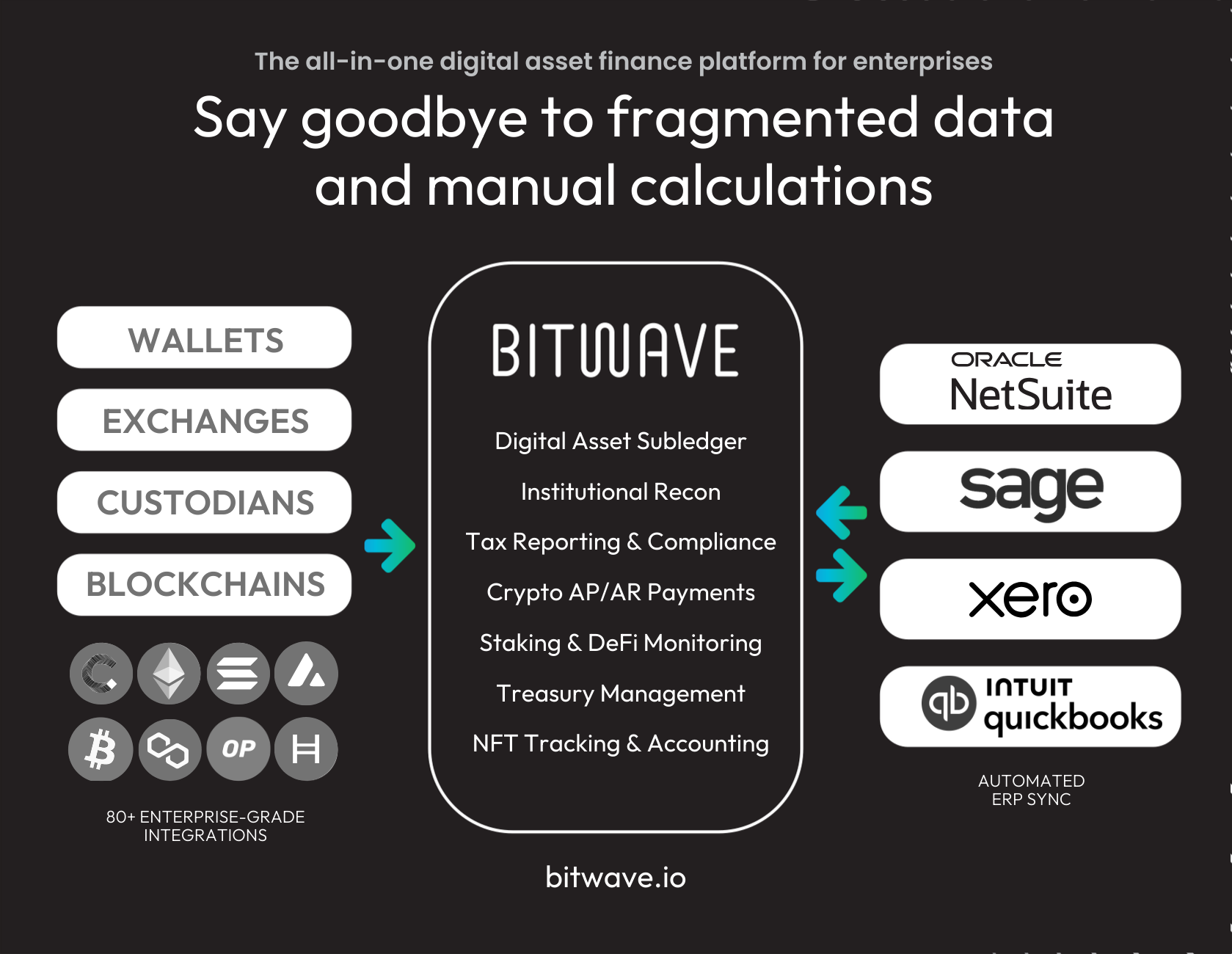
Bitwave sits between your blockchain activity and your financial systems, acting as an intelligent subledger that translates on-chain data into accounting-ready entries. Each pillar of a crypto treasury strategy maps directly to something Bitwave handles operationally.
Making Blockchain Data Finance-Ready
Every blockchain transaction coming into Bitwave gets enriched, categorized, and valued before it touches your ERP. Gas fees, staking rewards, smart contract interactions, protocol fees - Bitwave understands these natively and maps them to the correct accounting treatment. It supports FASB ASC 350-60 fair value measurement and IFRS simultaneously, so multinationals with different reporting requirements across jurisdictions aren't maintaining separate systems or manual adjustments to reconcile the difference.
Enforcing Governance Controls
The authorization layer is where most companies have nothing. Bitwave's approval workflows enforce who can authorize what - essential for multi-sig wallets, voting token decisions, or any treasury requiring proper segregation of duties. Critically, those authorizations are connected directly to the downstream audit trail, so when an auditor asks who approved a transaction and how it was recorded, you're producing that answer in minutes rather than reconstructing it from Slack messages.
Seeing Your Full Treasury Position
If your digital assets are spread across multiple wallets, exchanges, and custodians - which they should be, for diversification purposes - your treasury team needs a unified view of current positions without reconciling across spreadsheets. Bitwave consolidates that view in real time, giving controllers and treasury managers current valuations and exposure data they can actually act on.
Tracking Staking and Yield
Staking rewards and lending income are increasingly common ways crypto treasuries generate yield - but they create accounting and tax complexity that's easy to miss if you're tracking them manually. Bitwave captures these automatically, applies the correct accounting treatment, and tracks the tax implications, so the treasury can generate returns without creating a reconciliation problem at month-end or a surprise at tax time.
Syncing to Your ERP in Real Time
Bitwave syncs directly to Oracle, SAP, NetSuite, QuickBooks, and more - in real time, with full reconciliation. Companies with a purpose-built subledger like Bitwave typically close their books in two to three days. Companies without one spend the first week of every month manually reconciling spreadsheets.
When Your Treasury Holds Assets That Also Move Money
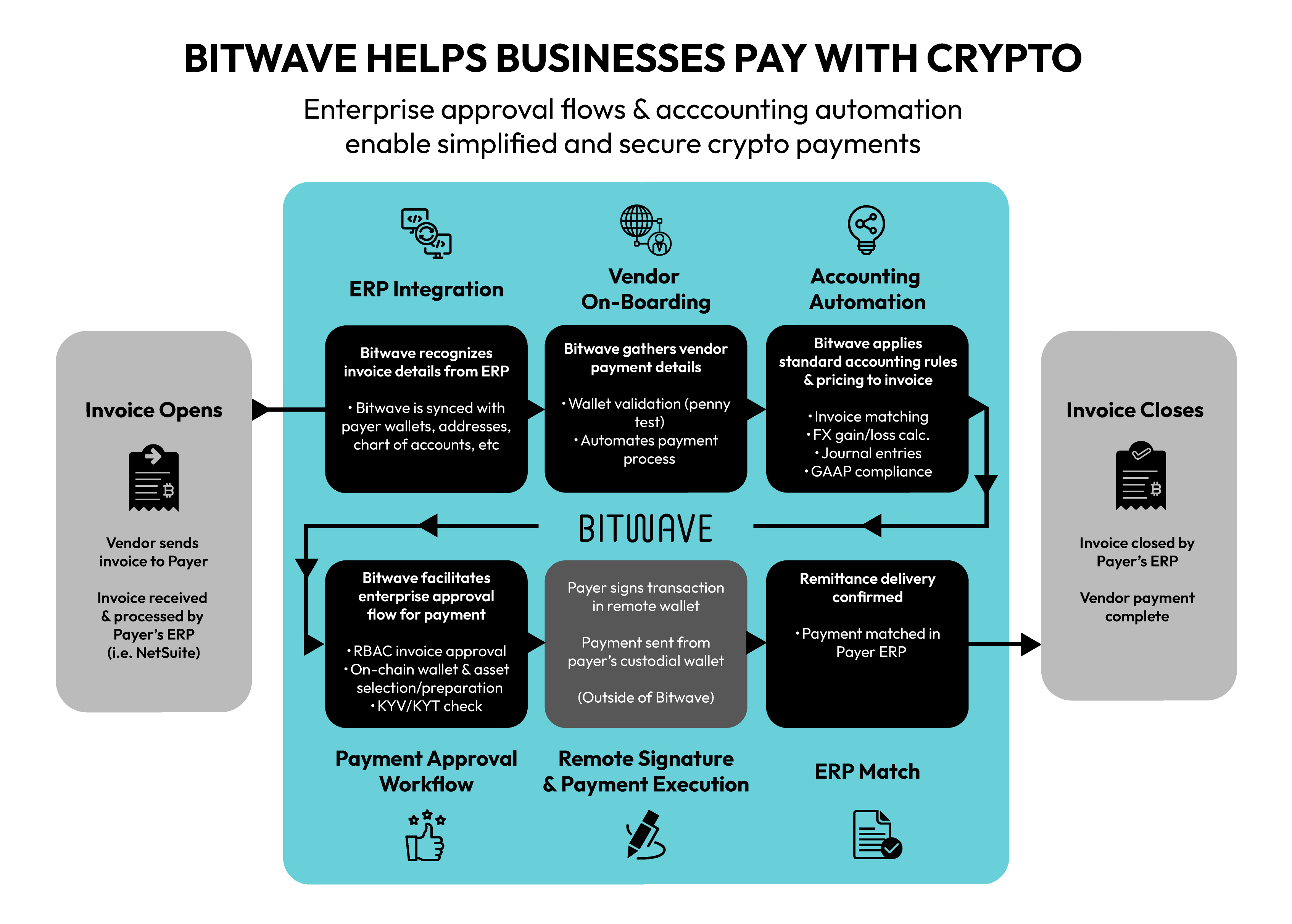
For companies using crypto for accounts payable or receivable - paying vendors in stablecoins or accepting crypto payments - the operational stakes are even higher. Every blockchain payment needs to tie back to an invoice or PO number for full traceability. Bitwave handles that connection, ensuring that the operational efficiency of stablecoin settlement (near-instant, no hidden fees, global reach) doesn't come at the cost of the controls your auditors and finance team need. The books still close on time. The audit trail is still there.
A Good Strategy Deserves Infrastructure That Can Execute It
A crypto treasury strategy is only as strong as the operations behind it. The governance framework doesn't matter if your approval workflows aren't enforced. The diversification thesis doesn't matter if you can't reconcile multi-custodian positions. The yield strategy doesn't matter if staking rewards are creating an accounting blind spot.
Software alone isn't always sufficient. Questions like "how should we structure our chart of accounts for digital assets?" or "what's the right cost basis method for our tax strategy?" aren't answered by documentation. That's why Bitwave works alongside advisory partners like Deloitte and RSM - combining the technical infrastructure with the accounting and compliance expertise that implementation actually requires.
If your organization has made the decision to hold digital assets, the strategic work is done. Bitwave handles what comes next.
Ready to see what the operational layer looks like? Schedule a demo to learn how leading enterprises are running their crypto treasury operations with Bitwave.
FAQs About Operational Layer Your Crypto Treasury Strategy Is Missing
What is a Crypto Treasury Strategy?
A crypto treasury strategy - sometimes called a Digital Asset Treasury , or DAT - is the formal practice of acquiring, holding, and managing digital assets such as Bitcoin, Ethereum, or stablecoins as a structured part of corporate treasury management. Rather than treating crypto as a one-off investment, a DAT strategy integrates digital assets into the company's broader financial playbook.
How Bitwave Handles the Execution Side of Your Treasury Strategy?
Bitwave sits between your blockchain activity and your financial systems, acting as an intelligent subledger that translates on-chain data into accounting-ready entries. Each pillar of a crypto treasury strategy maps directly to something Bitwave handles operationally.


Disclaimer: The information provided in this blog post is for general informational purposes only and should not be construed as tax, accounting, or financial advice. The content is not intended to address the specific needs of any individual or organization, and readers are encouraged to consult with a qualified tax, accounting, or financial professional before making any decisions based on the information provided. The author and the publisher of this blog post disclaim any liability, loss, or risk incurred as a consequence, directly or indirectly, of the use or application of any of the contents herein.