

Financial data is only valuable when you can actually put it to work.
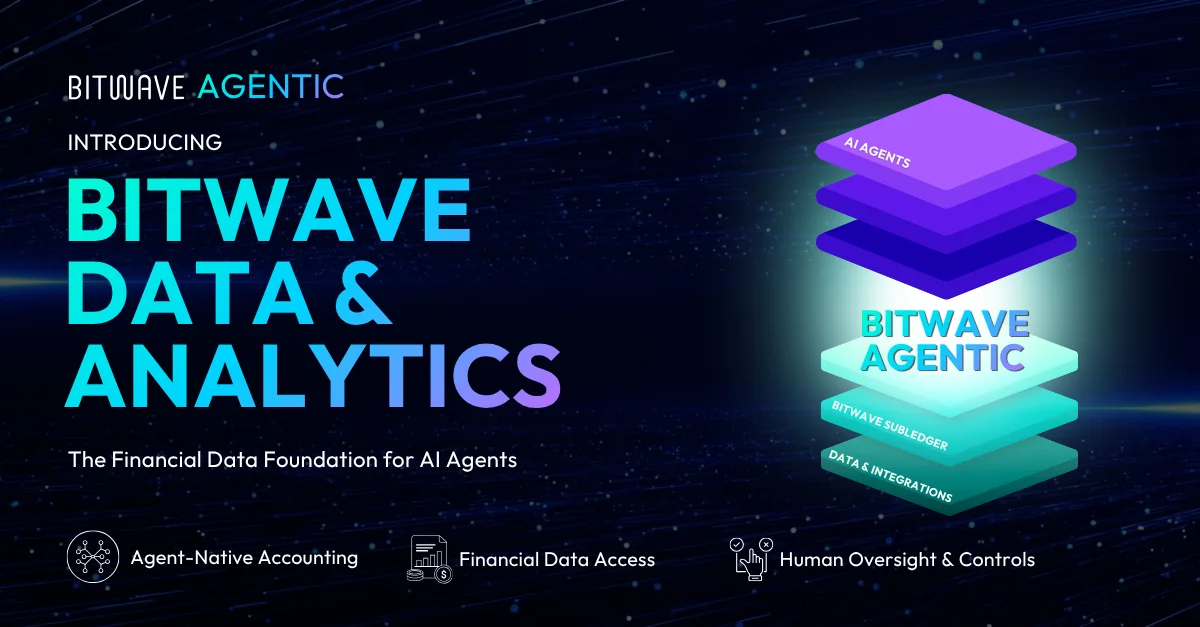
Today, we’re introducing Bitwave Data and Analytics, a new way for finance teams, developers, and AI agents to access, query, and analyze the extensive blockchain datasets Bitwave has built over the past eight years.
This release builds directly on the Bitwave CLI and Bitwave MCP. Together, these tools give AI agents a way to interact with financial systems and workflows. Bitwave Data and Analytics supplies another critical layer: clean, structured data they can use to answer questions and perform analysis.
Fast access to clean blockchain data
Bitwave is initially making datasets for Ethereum and Base available through the Bitwave CLI, with more on the way.
Users and agents can retrieve clean, formatted financial data on a per-token pricing model, providing a fast, cost-effective alternative to building and maintaining custom blockchain data infrastructure.
That data can support a wide range of research, accounting, and financial workflows, including:
- Retrieving activity associated with a specific wallet address
- Examining transactions involving a particular smart contract
- Measuring activity across a blockchain over a defined period
- Analyzing positions and loan-to-value ratios within decentralized finance protocols
- Supplying structured blockchain data to downstream financial models and workflows
Instead of assembling data from multiple sources, normalizing it, and writing custom infrastructure to keep it usable, teams can access it directly through Bitwave.
A SQL-driven analytics environment
Bitwave Data and Analytics also includes a SQL-driven analytics interface within the Bitwave platform.
Users can write and run queries against Bitwave’s datasets, extract specific data points, investigate addresses and contracts, and perform more complex financial analysis. The experience will be familiar to anyone who has used a blockchain analytics platform such as Dune, but it is built on Bitwave’s financial data infrastructure and designed to connect with the broader Bitwave platform.
The Analytics tab is available directly within Bitwave, making these datasets accessible through a visual interface as well as through the CLI.
Let your agent write the query
The real opportunity, however, is not simply giving people another place to write SQL. It is giving AI agents the data access they need to conduct analysis on a user’s behalf.
For example, a user could ask an agent:
Use the Bitwave CLI to calculate the total amount of ETH that changed hands during March 2024.
The agent can translate that request into the appropriate query, retrieve the relevant Ethereum data through Bitwave, perform the calculation, and present the result.
The user begins with a financial question, not a dataset, schema, or SQL statement.
That represents a fundamentally different way of working with blockchain data. Instead of requiring every user to learn how the underlying data is structured, Bitwave gives agents the tools to bridge the gap between natural-language questions and financial analysis.
One data layer across financial operations
Over time, the same analytics and query capabilities will extend into more areas of Bitwave, including treasury management and reconciliation.
That means the data used for one-off analysis will not live in isolation. The same underlying capabilities can support the operational workflows finance teams already manage through Bitwave while giving agents a consistent way to access and work with that information.
Bitwave Data and Analytics joins KubeClaw, Bitwave CLI and Bitwave MCP as another foundational component of Bitwave Agentic’s interconnected suite of infrastructure designed to make financial systems, workflows, and data accessible to both people and AI agents.
Explore Bitwave Agentic at bitwave.io/agentic or request early access to learn how to get started with Bitwave Data and Analytics.
FAQs Related to Bitwave Data and Analytics
What blockchain networks does Bitwave Data and Analytics currently support?
Bitwave is initially making datasets for Ethereum and Base available through the Bitwave CLI, with additional networks planned for the future.
What types of blockchain analysis can I perform with Bitwave Data and Analytics?
The platform supports a range of analyses including retrieving wallet activity, examining smart contract transactions, measuring blockchain activity over specific periods, analyzing DeFi positions and loan-to-value ratios, and supplying structured data to financial models.
How can AI agents use Bitwave Data and Analytics?
AI agents can translate natural language questions into SQL queries, retrieve relevant blockchain data through Bitwave, perform calculations, and present results without requiring users to write SQL or understand the underlying data structure.
Is there a SQL interface available for manual queries?
Yes, Bitwave includes a SQL-driven analytics interface similar to platforms like Dune, accessible both through a visual interface in the Bitwave platform and through the CLI for those who prefer writing queries directly.
How does Bitwave Data and Analytics integrate with other Bitwave tools?
The analytics and query capabilities are designed to work across the Bitwave platform and are expected to extend into treasury management and reconciliation, providing a consistent data layer for both one-off analysis and operational workflows.


Disclaimer: The information provided in this blog post is for general informational purposes only and should not be construed as tax, accounting, or financial advice. The content is not intended to address the specific needs of any individual or organization, and readers are encouraged to consult with a qualified tax, accounting, or financial professional before making any decisions based on the information provided. The author and the publisher of this blog post disclaim any liability, loss, or risk incurred as a consequence, directly or indirectly, of the use or application of any of the contents herein.