

Key Takeaways
- MCP accounting tools should be evaluated first by permission level: whether the AI can only read accounting data, can write changes directly, or can act only with human approval.
- The second important split is market fit: mainstream accounting platforms are adding MCP for fiat workflows, while separate vendors are building around crypto, stablecoins, and digital asset activity.
- Write access is already live in several accounting and spend platforms, so finance teams should treat MCP permissions as an immediate controls question rather than a future feature.
- For digital asset teams, human-in-the-loop workflows matter because AI can help categorize wallet activity or draft fixes, but posting changes still needs review.

AI assistants like Claude and ChatGPT can now connect directly to your accounting platform, read your books, and in a growing number of cases, take action inside them: categorizing transactions, drafting journal entries, even reconciling accounts. The technology behind this is called MCP, short for Model Context Protocol. You don't need to understand how it works under the hood. You do need to know who's offering it, what each actually lets your AI assistant do, and where the risks are.
So we built a map.
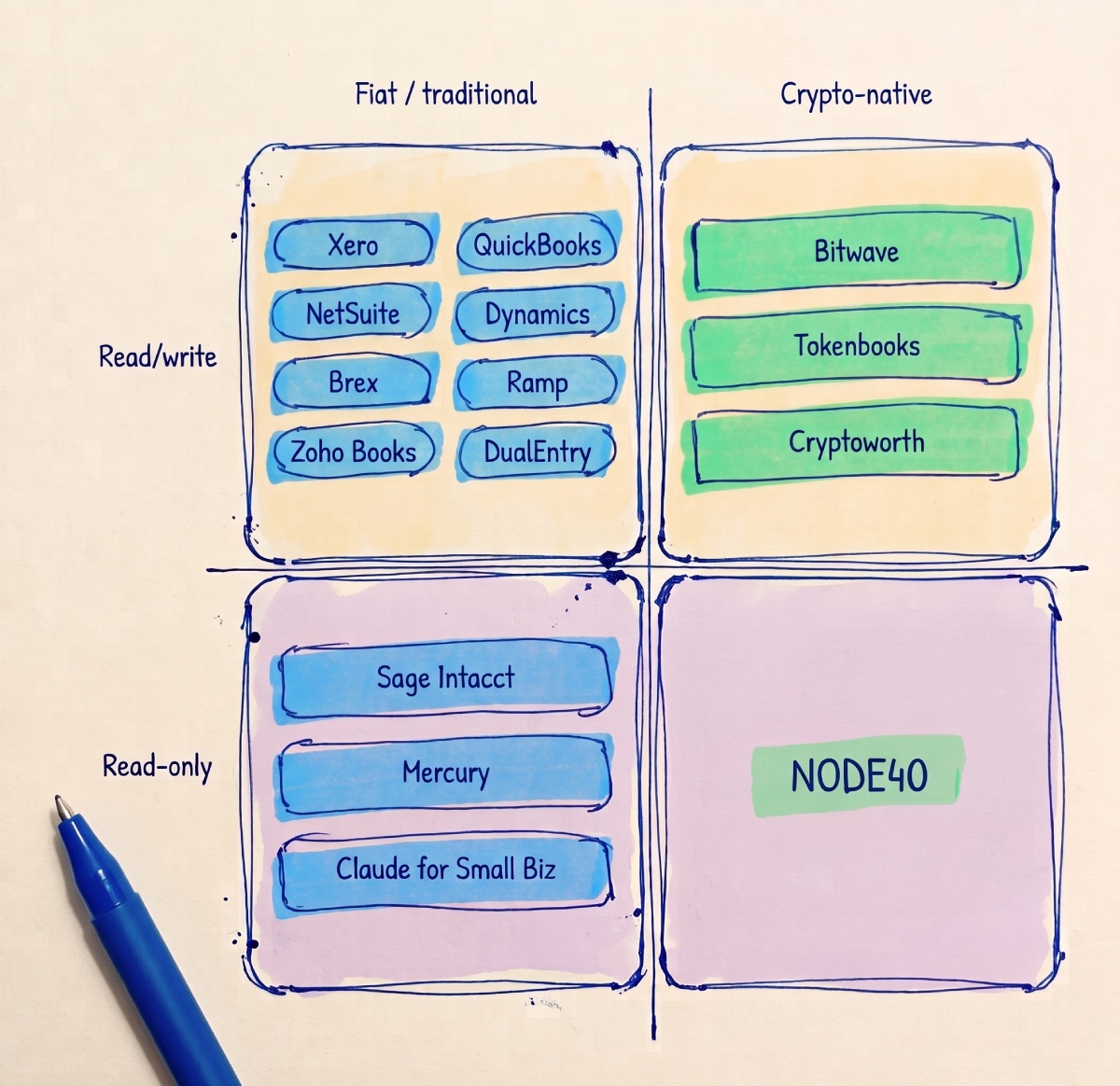
Two questions do most of the sorting
Once you look past the marketing language, every MCP accounting solution boils down to how it answers these two questions:
1. Can the AI only look, or can it also act? Some platforms let an AI read your data (balances, invoices, reports, etc.) and nothing more. Others let it create transactions, categorize expenses, or draft entries. A more cautious group falls in between: the AI can act, but a person has to approve first.
2. Is it built for traditional (fiat) accounting, or for crypto and digital assets? Mainstream accounting platforms are racing to add MCP support. A separate, faster-moving group of vendors is building specifically for companies that hold crypto, stablecoins, or other digital assets.
Plotting vendors against those two questions produces those four groups you see above. Let’s take a closer look at each.
Fiat, read/write solutions
This is the most crowded group and the one your team is most likely to touch first. Xero was the first big accounting platform to ship an official MCP connection with QuickBooks following soon after. Both now let an AI assistant create invoices, log bills, and pull financial reports on request, not just read them.
It’s not just small-business tools either. NetSuite and Dynamics 365 also now let an AI agent create or update a record directly, such as a vendor bill or a customer account, using the same role-based permissions a person would have. If your company runs on one of these systems, it's already available today to whoever holds the right permissions.
Spend platforms round out the group: employees can ask an AI to file an expense or check a vendor's payment history, and Ramp has gone as far as issuing corporate cards directly to AI agents, with spending limits built in.
The common thread among them all is that none of these vendors treat write access as a future risk to manage. It's live today, and the only safeguard is the same role-based permission your team already assigns to human users.
Fiat, read-only solutions
A smaller group, including Sage Intacct and the banking platform Mercury, made a deliberate choice to keep their MCP connections read-only for now. You can chat with your AI to analyze the data, but it can't change anything. Given how new this technology is, that's arguably the safer starting point, and it's a good idea to ask any vendor why they landed on one side or the other.
Crypto-native, read/write solutions
This group helps companies holding crypto or other digital assets, a category traditional accounting software wasn't designed to handle. Bitwave offers an MCP server that lets an AI assistant work with wallet data directly: categorizing transactions, filtering activity, and pulling balance reports, without someone first exporting anything into a spreadsheet. The AI can propose a change, such as a draft journal entry or a fix for an unexplained wallet balance, but a person has to sign off before anything posts. That's part of the "human-in-the-loop" design.
Crypto-native, read-only solutions
NODE40 sits here, giving an AI assistant a way to query portfolios, audit transaction history, and pull reports on digital asset holdings. The tool has no way to save, post, or execute anything though. Your AI assistant using it can suggest a fix in conversation, but turning that into an actual change still means a person entering it by hand, outside the tool entirely.
The bottom line
MCP accounting is still young, but the direction is clear: AI assistants are moving from answering questions about your books to working inside them.
None of these vendors are still asking whether AI belongs in the ledger. They're asking how much of it you're ready to hand over.
FAQs Related to AI Accounting Assistants and MCP Integration
What is MCP and how does it allow AI to work with accounting software?
MCP (Model Context Protocol) is the technology that enables AI assistants like Claude and ChatGPT to connect directly to accounting platforms, read financial data, and in some cases take actions within those systems. You don't need to understand the technical details, but understanding what each vendor allows your AI assistant to do is important.
What's the difference between read-only and read/write MCP accounting solutions?
Read-only solutions allow AI assistants to analyze and report on your financial data but cannot make changes. Read/write solutions enable AI to take actions like categorizing transactions, creating invoices, or drafting journal entries—either immediately or after human approval, depending on the vendor.
Which major accounting platforms currently offer MCP connections?
Xero and QuickBooks were among the first mainstream platforms to offer MCP support, followed by NetSuite and Dynamics 365. These platforms allow AI assistants to create invoices, log bills, and pull financial reports. Spend platforms like Ramp also offer MCP integration.
How do crypto-focused MCP solutions differ from traditional accounting platforms?
Crypto-native MCP solutions like Bitwave and NODE40 are designed to handle digital assets and wallet data, which traditional accounting software wasn't built for. They allow AI assistants to work with blockchain-based transactions and portfolio data directly without manual spreadsheet exports.
What safeguards are in place when AI has write access to accounting systems?
Some vendors use role-based permissions similar to human users, while others require human approval before changes take effect. Others have opted for read-only access as a safer starting point given how new the technology is. It's worth asking vendors why they chose their approach.

Disclaimer: The information provided in this blog post is for general informational purposes only and should not be construed as tax, accounting, or financial advice. The content is not intended to address the specific needs of any individual or organization, and readers are encouraged to consult with a qualified tax, accounting, or financial professional before making any decisions based on the information provided. The author and the publisher of this blog post disclaim any liability, loss, or risk incurred as a consequence, directly or indirectly, of the use or application of any of the contents herein.